- Non-native writers
- Writing
- Manual paraphrasing
Rewriting in English when it's not your first language
Practical habits for non-native English writers who want clear, natural text without handing their words to an automatic rewriter.
· 2 min read
If English is your second language, rewriting is where most of the work happens. The ideas are already there. Getting them into sentences that sound natural is the slow part. Automatic rewriters are tempting, but they replace your voice with a generic one, and you can't always tell when they changed what you meant. These habits help you improve the text yourself.
Why rewrite manually at all?
Two reasons. First, you stay sure of the meaning: you know what you wanted to say, and every word in the result is one you chose. Second, you get better. Each sentence you fix yourself teaches you a pattern you'll use next time. An automatic rewrite gives you a result but teaches nothing.
Work one sentence at a time
Long paragraphs are overwhelming in any language. Focus on one sentence, make it right, then move on. Keep the sentences before and after in view, so your fixes still connect. Most problems in second-language writing are local: word order, articles, prepositions, tense. They are much easier to spot when one sentence is in front of you.
Prefer short, clear sentences
Native-sounding English is often simpler than people expect. If a sentence feels wrong and you can't fix it, split it in two.
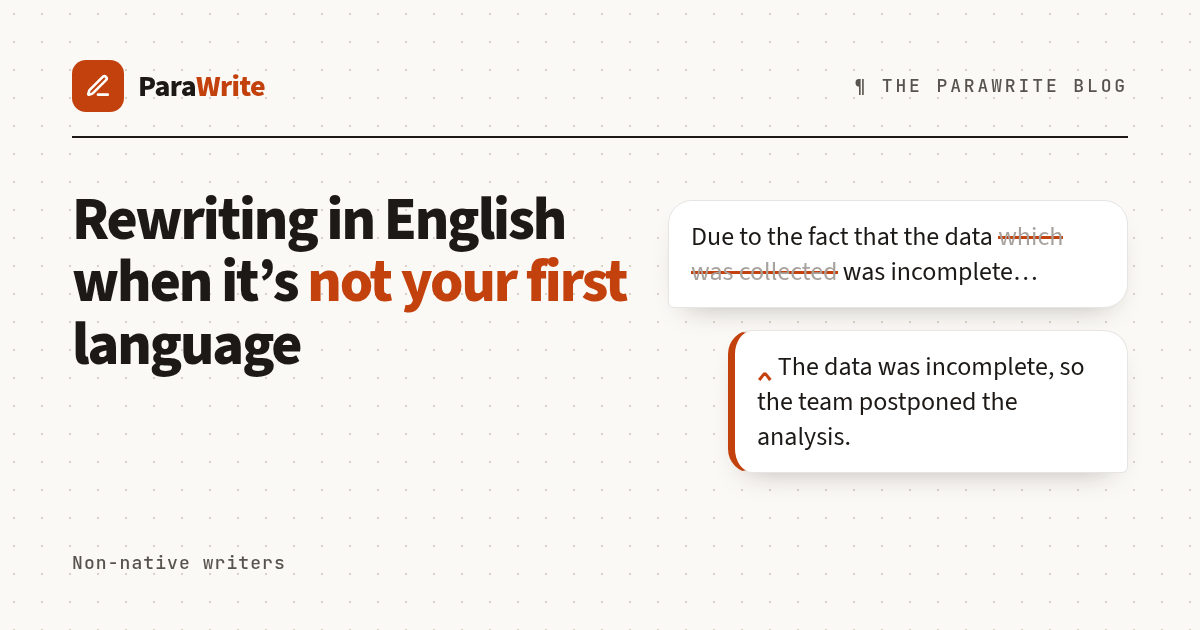
Before: Due to the fact that the data which was collected was incomplete, it was decided by the team that the analysis should be postponed.
After: The data was incomplete, so the team postponed the analysis.
Check the usual suspects
When you review a sentence, check these in order:
- Subject and verb agree ("the results show", "the data was").
- Articles: a, an, the, or none.
- Prepositions: "interested in", "depend on", "responsible for".
- Tense stays consistent within the paragraph.
- Word order in questions and with adverbs ("I often write", not "I write often" in most cases).
Watch for false friends
Some words look like a word in your language but mean something different in English. If a word "feels" right only because it's similar to your native language, check a dictionary that gives example sentences.
Read it aloud
Your ear often catches what your eye misses. If you stumble while reading a sentence aloud, a reader will stumble too. Rewrite it.
Keep a personal list
Write down the corrections you make most often: a preposition you always get wrong, an article rule, a phrase you overuse. Review it before you start editing. Over time the list gets shorter.
How ParaWrite helps
ParaWrite is built for this kind of focused, sentence-level work. Paste your draft and it splits it into sentences. You see one at a time with the original above an editable copy and the surrounding text beside it. It never rewrites for you, so the final text is genuinely yours. At the end, the Changes view shows every sentence you rewrote next to the original, which is a good way to learn from your own edits.
More on the method: how to paraphrase without changing the meaning.